• The Digital Personal Data Protection Act (DPDPA), 2023 is India’s landmark legislation aimed at safeguarding personal data in the digital age. With increasing cyber threats and data misuse, this Act ensures that individuals have control over their personal information while businesses follow strict compliance norms.

    Why Was This Act Introduced?

    India is one of the fastest-growing digital economies, with millions of users sharing personal data online every day. From banking apps to e-commerce platforms, data is everywhere.

    The DPDPA was introduced to:

    • Protect individuals’ privacy.
    • Prevent misuse of personal data.
    • Establish accountability for organizations handling data.
    Key Features of the Act
    1. Consent-Based Data Processing

    Organizations must obtain clear consent before collecting or processing personal data.

    2. Rights of Individuals (Data Principals)

        • Right to access information about how your data is used.

        • Right to correct or delete your data.

        • Right to withdraw consent anytime.

    3. Obligations for Businesses (Data Fiduciaries)

        • Implement reasonable security safeguards.

        • Report data breaches promptly.

        • Appoint a Data Protection Officer for compliance.

    4. Penalties for Non-Compliance

    Fines can go up to ₹250 crore for serious violations.

    Impact on Financial Sector

    Banks, NBFCs, and fintech companies handle sensitive data like Aadhaar, PAN, and transaction details. Under DPDPA:

    • Customer consent becomes mandatory for every data use.
    • Data minimization: Collect only what is necessary.
    • Strong encryption and breach reporting are essential.

    Example:

    If a bank uses customer data for marketing without consent, it can face heavy penalties under the Act.

    How Can Businesses Prepare?
    • Conduct Data Protection Impact Assessments.
    • Train employees on privacy compliance.
    • Update IT systems for secure storage and transfer.
    What Does It Mean for You as a Consumer?
    • You have the right to know how your data is used.
    • You can request deletion of your data from any platform.
    • You can report misuse to the Data Protection Board.
    Final Thoughts

    The DPDPA is a big step toward making India’s digital ecosystem safer and more transparent. For businesses, compliance is not optional hence it’s a necessity. For individuals, it’s a win for privacy and security.
  • The Digital Personal Data Protection Act (DPDPA), 2023 is a game-changer for India’s financial ecosystem. For RBI-regulated entities like banks, NBFCs, payment aggregators, and fintech companies, compliance is not just a legal requirement but it’s essential for customer trust and operational integrity.

    Let’s break down practical steps to ensure compliance without getting lost in legal jargon.

    1.Understand the Scope

    DPDPA applies to digital personal data collected online or digitized offline. For RBI-regulated entities, this includes:

    • Customer KYC details (Aadhaar, PAN)
    • Transaction history
    • Mobile numbers, email IDs
    • Sensitive financial data
    2. Obtain Explicit Consent
    • Before collecting data, ensure customers give clear, informed consent.
    • Consent should be:
      • Specific (for a defined purpose)
      • Revocable (customers can withdraw anytime)
    • Example:
      When onboarding a customer for a savings account, include a digital consent form explaining why data is collected and how it will be used.
    3. Implement Data Minimization
    • Collect only what is necessary for the service.
    • Example:
      If you are offering a credit card, do not ask for unrelated details like family income unless required for risk assessment.
    4. Strengthen Security Measures
    • Use end-to-end encryption for data in transit and at rest.
    • Enable multi-factor authentication for internal systems.
    • Regularly conduct penetration testing and vulnerability assessments.
    5. Appoint a Data Protection Officer (DPO)
    • RBI-regulated entities handling large volumes of data must appoint a DPO.
    • The DPO will:
      • Monitor compliance
      • Handle customer grievances
      • Liaise with the Data Protection Board of India
    6. Create a Breach Response Plan
    • Under DPDPA, data breaches must be reported promptly.
    • Steps:
      • Maintain a 24×7 incident response team.
      • Notify RBI and the Data Protection Board
      • Inform affected customers transparently
    7. Align with RBI Guidelines

    DPDPA compliance should integrate with existing RBI frameworks like:

    • Cyber Security Framework for Banks.
    • IT Governance Guidelines
    • Outsourcing of IT Services Circular (April 2023)

    Example:

    If you outsource cloud services, ensure the vendor complies with DPDPA and RBI norms.

    8. Train Employees
    • Conduct privacy awareness sessions.
    • Include DPDPA compliance modules in onboarding programs.
    • Example:
      • Train branch staff to handle consent forms correctly and avoid unauthorized data sharing.
    9. Maintain Audit Trails
    • Keep records of:
      • Consent obtained
      • Data processing activities
      • Breach reports
    • This helps during RBI inspections and audits.
    10. Prepare for Penalties

    Non-compliance can lead to fines up to ₹250 crore.

    Invest in compliance technology now to avoid future risks.

    Checklist for RBI-Regulated Entities
    • Consent Management System
    • Data Encryption & Secure Storage
    • Breach Reporting Mechanism
    • DPO Appointment
    • Employee Training
    • Vendor Compliance Verification
    Final Thoughts

    DPDPA compliance is not just about avoiding penalties, it’s about building trust in India’s digital financial ecosystem. Start early, integrate compliance into your operations, and stay ahead of regulatory changes.

  • In today’s digital-first financial landscape, fraud is evolving faster than ever. From phishing emails to fake transactions, fraudsters are using sophisticated tactics to exploit vulnerabilities. But there’s good news Machine Learning (ML) is stepping up as a powerful ally in the fight against financial fraud.

    In this blog, we’ll explore how ML models are being used to detect and prevent fraud in real-time, especially in the Indian financial sector, and how they continuously learn to stay ahead of fraudsters.

    What is Fraud Detection?

    Fraud detection refers to identifying suspicious activities that could indicate financial fraud like unauthorized transactions, identity theft, or money laundering. In India, banks, NBFCs, and fintech platforms are increasingly relying on AI and ML algorithms to monitor and analyze transaction patterns.

    How Machine Learning Helps in Fraud Detection
    1. Real-Time Transaction Monitoring

    ML models analyze thousands of transactions per second. They look for unusual patterns like sudden large withdrawals, multiple failed login attempts, or transactions from unfamiliar locations.

    Example: If a customer from Mumbai suddenly makes a high-value transaction from Russia at 3 AM, the system flags it as suspicious.

    2. Behavioral Analysis

    ML systems learn user behavior over time. If a user typically spends ₹5,000 per month and suddenly spends ₹50,000, the system raises an alert.

    3. Adaptive Learning

    Fraud tactics keep changing. ML models are trained to continuously learn from new data, adapting to new fraud techniques like UPI scams or fake loan apps.

    4. Reducing False Positives

    Traditional systems often flag genuine transactions as fraud. ML improves accuracy by learning what’s normal for each user, reducing unnecessary alerts.

    Use Cases in Indian Financial Sector
    Banks

    Banks like SBI, HDFC, and ICICI use ML to monitor ATM withdrawals, online banking, and card transactions.

    UPI & Mobile Wallets

    Apps like PhonePe, Google Pay, and Paytm use ML to detect fake UPI requests and prevent phishing.

    Loan Disbursement

    Fintechs use ML to verify borrower identity and detect fake documents during loan applications.

    Popular Machine Learning Models Used
    • Decision Trees: For rule-based fraud detection.
    • Random Forests: For high accuracy in complex datasets.
    • Neural Networks: For deep pattern recognition.
    • Isolation Forests: To detect anomalies in large datasets.
    Compliance with RBI Guidelines

    The Reserve Bank of India (RBI) mandates financial institutions to have robust fraud detection systems. ML helps meet these compliance requirements by offering:

    • Real-time alerts
    • Audit trails
    • Risk scoring
    • Automated reporting
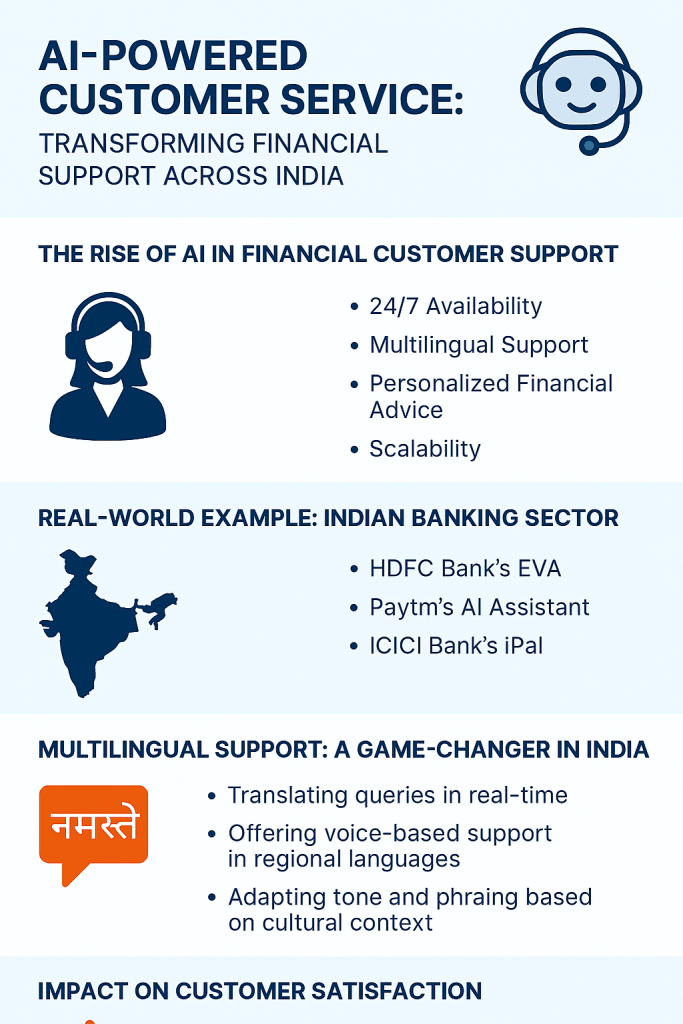
  • In today’s fast-paced digital economy, customer expectations are higher than ever. They want instant support, personalized advice, and communication in their preferred language. For financial institutions in India, meeting these demands across a linguistically diverse population is a challenge but one that AI-powered chatbots and virtual assistants are solving with remarkable efficiency.

    At FinSequr.com, we explore how artificial intelligence is revolutionizing customer service in the financial sector, enhancing satisfaction, trust, and accessibility.

    The Rise of AI in Financial Customer Support

    AI-powered tools like chatbots and virtual assistants are now integral to customer service strategies. These systems use natural language processing (NLP) and machine learning to understand queries, provide accurate responses, and learn from interactions.

    Key Benefits:
    • 24/7 Availability
      Customers can get help anytime—no waiting for business hours.
    • Multilingual Support
      AI can communicate in Hindi, Marathi, Tamil, Bengali, Kannada, and more, making financial services inclusive.
    • Personalized Financial Advice
      Based on customer data, AI can recommend savings plans, credit options, or investment strategies.
    • Scalability
      Handle thousands of queries simultaneously without compromising quality.
    Real-World Example: Indian Banking Sector

    Several Indian banks and fintech companies have already adopted AI-powered customer service:

    • HDFC Bank’s EVA
      One of India’s first AI chatbots, EVA answers millions of queries in English and Hindi, helping customers with account details, loan options, and branch locations.
    • Paytm’s AI Assistant
      Offers multilingual support and personalized financial tips based on user behavior.
    • ICICI Bank’s iPal
      Available 24/7, it helps users with transactions, card services, and investment queries in multiple languages.
    How AI Understands and Responds

    AI chatbots use:

    • Natural Language Understanding (NLU) to interpret user intent.
    • Sentiment Analysis to detect frustration or urgency.
    • Contextual Memory to maintain conversation flow.
    • Secure APIs to fetch real-time financial data safely.
    Multilingual Support: A Game-Changer in India

    India has 22 official languages and hundreds of dialects. Traditional customer service often struggles to cater to this diversity. AI bridges this gap by:

    • Translating queries in real-time.
    • Offering voice-based support in regional languages.
    • Adapting tone and phrasing based on cultural context.

    Example: A customer in Pune can ask a chatbot in Marathi about loan eligibility, while another in Chennai can get investment advice in Tamil—instantly and accurately.

    Impact on Customer Satisfaction
    • Faster Resolution Times
      No hold music or long queues just instant answers.
    • Higher Engagement
      Personalized responses make customers feel valued.
    • Improved Retention
      Happy customers are more likely to stay and recommend services.
    Security and Compliance

    AI systems in financial services must comply with RBI guidelines on data privacy and cybersecurity. At FinSequr, we ensure that AI tools are:

    • Secure – End-to-end encrypted.
    • Compliant – Aligned with RBI’s IT and cybersecurity frameworks.
    • Auditable – Maintain logs for transparency and accountability.
    Final Thoughts

    AI-powered customer service is not just a trend it’s the future of financial engagement in India. By offering personalized, multilingual, and round-the-clock support, financial institutions can build stronger relationships, improve operational efficiency, and stay ahead in a competitive market.

    At FinSequr, we help organizations integrate secure, compliant, and intelligent AI solutions tailored to India’s unique financial landscape.

  • In the fast-evolving digital landscape, cybersecurity awareness and training (AT) are no longer optional they’re essential. Especially in the Indian financial sector, where sensitive data and digital transactions are at the heart of operations, empowering employees with the right knowledge can make all the difference.

    At FinSequr, we believe that a secure organization starts with informed people. This post explores how structured awareness programs and role-based training can strengthen your cybersecurity posture and align with national standards like CERT-In and RBI guidelines.

    What is Awareness & Training (AT) in Cybersecurity?

    Awareness and Training (AT) refers to educating employees, contractors, and stakeholders about cybersecurity risks, policies, and best practices. It’s about turning your workforce into your first line of defense.

    AT.1: Basic Cybersecurity Awareness Training – Twice a Year

    To build a culture of security, organizations should conduct biannual training covering:

    Key Topics:
    • Phishing Attacks
      Teach how to identify fake emails and malicious links.
      Example: A cooperative bank in Maharashtra reduced phishing incidents by 50% after mock drills.
    • Password Hygiene
      Promote strong passwords and multi-factor authentication (MFA).
    • Social Engineering
      Train employees to recognize manipulation tactics used by attackers.
    • BYOD Risks
      Educate on secure use of personal devices for work.
    • Safe Internet Usage
      Encourage secure browsing and discourage use of public Wi-Fi for sensitive tasks.
    • Acceptable Use Policies
      Clarify what’s allowed on company systems and networks.
    • Handling Sensitive Information
      Teach classification, encryption, and secure sharing practices.
    • Responsible Email Practices
      Avoid forwarding sensitive data and verify sender authenticity.
    AT.2: Participate in National Cybersecurity Initiatives
    Collaborate with CERT-In:

    India’s Computer Emergency Response Team (CERT-In) conducts regular:

    • Cybersecurity workshops
    • Capacity-building programs
    • National-level drills

    Why participate?

    • Stay updated on emerging threats
    • Test your incident response capabilities
    • Build connections with cybersecurity experts

    Example: A fintech firm in Bengaluru joined CERT-In’s ransomware drill and discovered critical gaps in their recovery plan.

    Role-Based Training: Tailored for Every Function

    Not all roles face the same risks. Customize training for:

    • IT Teams – Threat detection, patching, and incident response.
    • Finance Teams – Fraud prevention, secure payment handling.
    • Executives – Strategic risk awareness and compliance.

    Example: A digital payments company in Pune created role-specific modules and saw a 40% drop in internal security incidents.

    Benefits of a Strong AT Program
    • Reduced risk of data breaches
    • Improved compliance with RBI cybersecurity framework
    • Enhanced employee confidence and accountability
    • Faster incident detection and response
    Final Thoughts

    Cybersecurity is not just a technical issue it’s a people issue. By investing in Awareness and Training, financial institutions in India can build a resilient, security-first culture.

    At FinSequr.com, we help organizations design and implement effective AT programs aligned with regulatory standards and industry best practices.

  • In cybersecurity, not every threat comes with flashing lights and alarms. Some creep in quietly through unauthorized access, privilege misuse, or suspicious network activity. That’s why Logging and Monitoring (LM) is essential. It’s the silent guardian that watches, records, and alerts when something goes wrong.

    This blog explores how Indian organizations, especially in the financial sector, can implement continuous logging and monitoring to ensure traceability, accountability, and compliance with national regulations.

    What is Logging and Monitoring?

    Logging is the process of recording events and activities across your IT systems like who logged in, what files were accessed, and which commands were executed.

    Monitoring is the act of watching these logs in real-time or near-real-time to detect anomalies, threats, or policy violations.

    Together, they form the backbone of cyber incident detection and response.

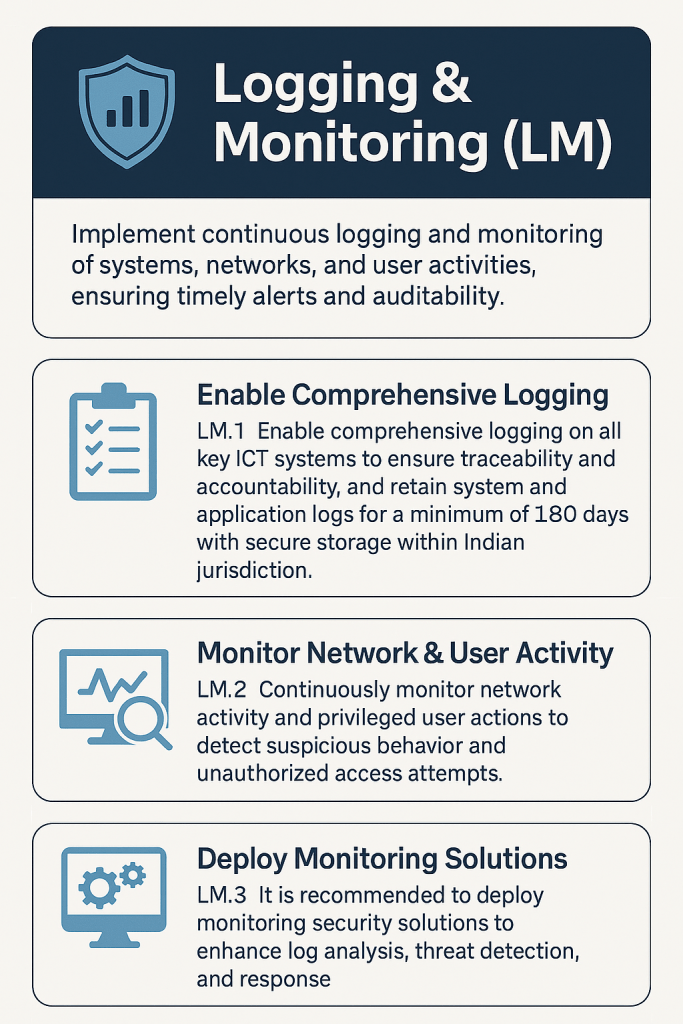
    LM.1 Enable Comprehensive Logging Across All Key ICT Systems

    Start by enabling logging on all critical systems:

    • Servers and databases
    • Firewalls and routers
    • Applications and cloud platforms
    • User access and authentication systems

    Logs should capture:

    • User activities (logins, file access, changes)
    • System events (errors, updates, restarts)
    • Network traffic (IP addresses, ports, protocols)

    Example: A private bank in Mumbai configures its core banking system to log every admin login, transaction override, and failed access attempt.

    Retention & Storage:

    • Retain logs for at least 180 days.
    • Store logs securely within Indian jurisdiction to comply with data localization norms.

    Tip: Use encrypted storage and access controls to prevent tampering.

    LM.2 Monitor Network Activity & Privileged User Actions

    Monitoring should focus on:

    • Privileged users (admins, developers, auditors)
    • Network traffic (unusual data transfers, port scans)
    • Access patterns (logins from unknown locations or odd hours)

    Use tools like:

    • SIEM (Security Information and Event Management)
    • IDS/IPS (Intrusion Detection/Prevention Systems)
    • Endpoint Detection & Response (EDR)

    Example: A fintech firm in Bengaluru uses a SIEM tool to detect when a developer accesses production data outside business hours.

    LM.3 Deploy Security Monitoring Solutions

    To make sense of massive log data, deploy smart tools that offer:

    • Automated log analysis
    • Real-time threat detection
    • Alerting and incident response workflows

    Popular solutions include:

    • Splunk
    • ELK Stack (Elasticsearch, Logstash, Kibana)
    • QRadar
    • Azure Sentinel

    Choose tools that integrate well with your existing infrastructure and support Indian compliance standards.

    Compliance Snapshot
    • RBI Cybersecurity Framework: Emphasizes logging and monitoring for banks and NBFCs.
    • CERT-In Guidelines: Require timely detection and reporting of cyber incidents.
    • IT Act, 2000 (Section 70B): Mandates secure logging and incident reporting.
    Final Thoughts

    Logging and Monitoring may not be flashy, but they’re critical for cybersecurity hygiene. By enabling comprehensive logging, monitoring privileged actions, and deploying smart analysis tools, organizations can detect threats early, respond faster, and stay compliant.

    In a world where cyber threats evolve daily, LM is your first alert system quietly working behind the scenes to keep your digital assets safe.

  • In today’s digital-first world, cybersecurity incidents are not rare they’re routine. Whether it’s a phishing email targeting a bank employee or a ransomware attack on a fintech startup, the ability to respond quickly and effectively can make all the difference.

    This post explores how organizations can build a strong IM framework to detect, report, respond to, and recover from cyber incidents, while staying compliant with Indian laws like the Information Technology Act, 2000 and CERT-In guidelines.

    That’s where Incident Management (IM) comes in a structured process to detect, report, respond to, and recover from cyber threats.

    What is Incident Management?

    Incident Management is like your organization’s emergency response system for cyber threats. It ensures that when something goes wrong like a data breach or malware infection there’s a clear plan to handle it.

    Why it matters: A delayed or uncoordinated response can lead to data loss, financial damage, and regulatory penalties.

    Think of it like a fire drill for your IT systems. You don’t wait for the fire to start you prepare in advance.

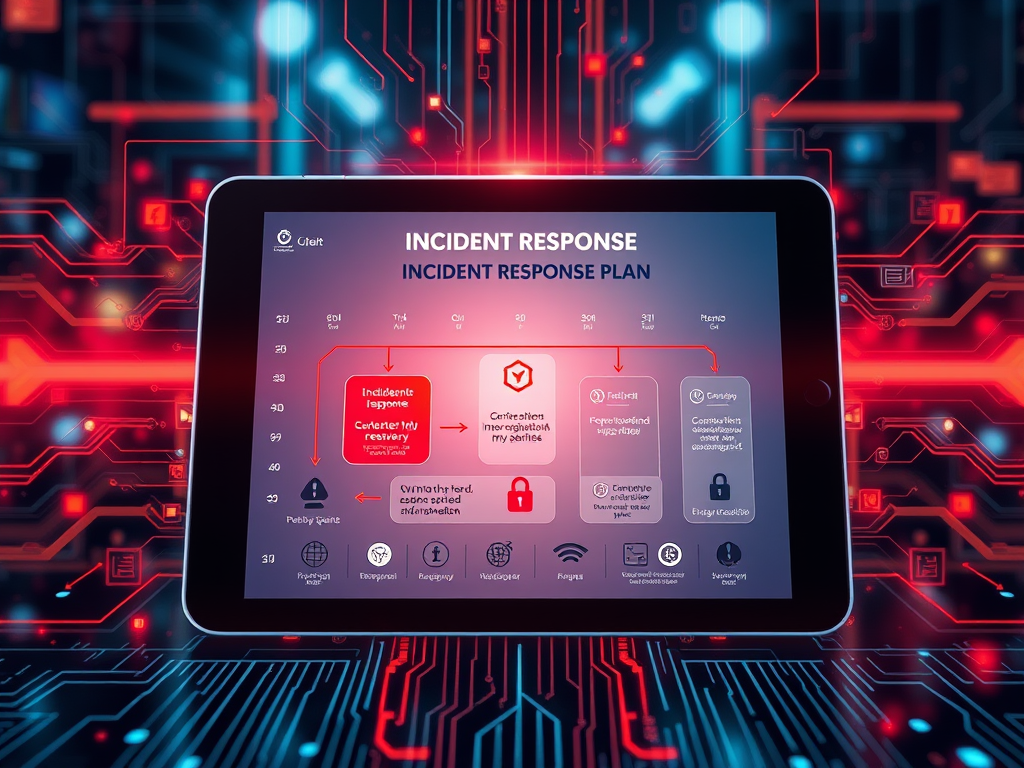
    IM.1 Create a Formal Incident Response Plan (IRP)

    The first step is to develop and document an Incident Response Plan (IRP). This plan should cover:

    • Reporting: Who should report the incident? How? To whom?
    • Containment: How do you isolate affected systems to prevent further damage?
    • Investigation: What tools and teams will analyze the breach?
    • Recovery: How do you restore operations safely?
    • Communication: Who needs to be informed—internal teams, regulators, customers?

    Example: A Mumbai-based NBFC discovers unauthorized access to its customer database. The IRP should guide the team to report the breach, isolate the server, investigate the entry point, recover the data securely, and notify CERT-In and affected customers.

    IM.2 Test Your IRP Regularly

    Having a plan is great but testing it is crucial. Conduct regular mock drills, simulations, and tabletop exercises to ensure your team knows what to do during a real incident.

    • Simulate phishing attacks or insider threats.
    • Review how quickly teams respond.
    • Identify gaps in coordination or tools.

    Example: A cooperative bank in Pune runs a quarterly drill where a fake ransomware alert is triggered. The IT team practices containment, while compliance checks reporting timelines.

    IM.3 Follow CERT-In Guidelines & Legal Requirements

    Under Section 70B(6) of the Information Technology Act, 2000, organizations must:

    • Follow cybersecurity practices published by CERT-In (India’s nodal agency for cyber incident response).
    • Report any cybersecurity incident within 6 hours of detection or notification.

    Visit https://www.cert-in.org.in/ for the latest advisories, reporting formats, and compliance updates.

    Example: If a fintech firm in Bengaluru detects a data leak at 10 AM, it must report it to CERT-In by 4 PM the same day.

    Final Thoughts

    Incident Management isn’t just a technical requirement it’s a business necessity. In a sector where trust is everything, being prepared for cyber incidents helps protect your reputation, customer data, and regulatory standing.

    By formalizing your IRP, testing it regularly, and aligning with CERT-In’s directives, you build a cyber-resilient culture that’s ready for anything.

  • Patch Management is one of the most critical cybersecurity practices, yet it’s often underestimated. Every day, vendors release patches to fix vulnerabilities that attackers exploit. Ignoring these updates can leave your systems exposed to ransomware, data breaches, and compliance violations.

    This comprehensive guide explains why patch management matters, best practices, compliance requirements, real-world examples, and answers common questions.

    Why Patch Management Matters

    Unpatched systems are a hacker’s playground. According to industry reports:

    • Over 60% of breaches occur due to missing patches.
    • Attackers exploit known vulnerabilities within days of disclosure.
    • Regulatory frameworks like ISO 27001, NIST, and CERT-In mandate timely patching.
    FinSequr’s Patch Management Best Practices
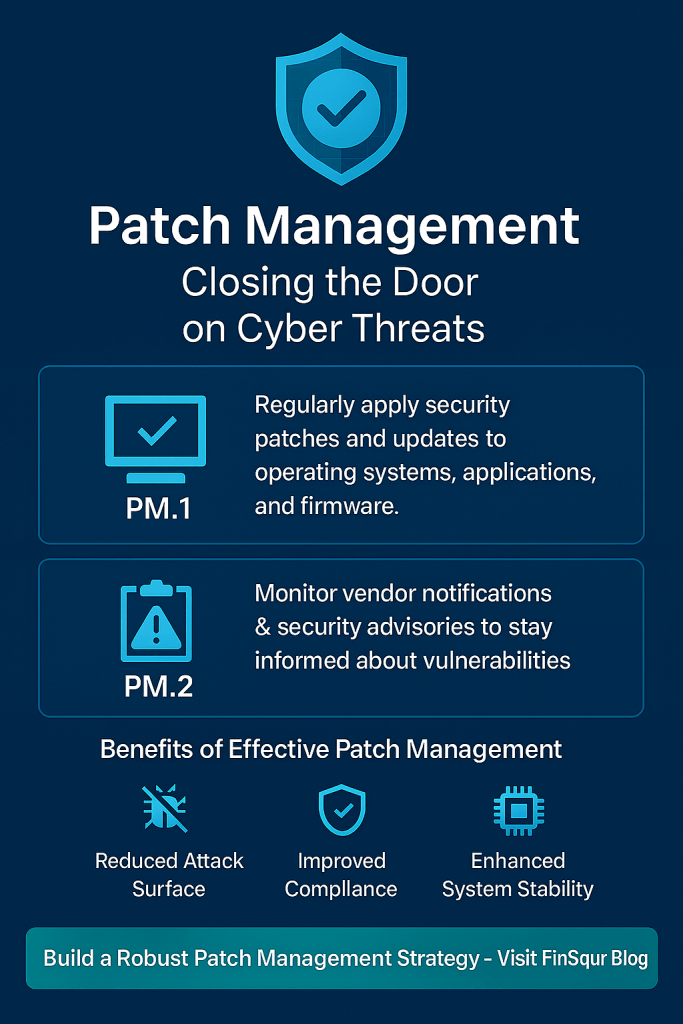
    PM.1: Apply Security Patches Regularly
    • Update operating systems, applications, and firmware promptly.
    • Automate patch deployment where possible to reduce human error.
    • Schedule maintenance windows for critical updates to minimize downtime.
    PM.2: Stay Informed About Vulnerabilities
    • Monitor:
      • Vendor notifications
      • Security advisories
      • CERT-In alerts
    • Subscribe to trusted threat intelligence feeds.
    • Maintain a patch inventory and prioritize based on severity.
    Benefits of Effective Patch Management
    • Reduced Attack Surface: Close known vulnerabilities before attackers exploit them.
    • Improved Compliance: Meet regulatory requirements and avoid penalties.
    • Enhanced System Stability: Patches often include performance improvements.
    Real-World Example

    In 2017, the WannaCry ransomware attack exploited a known vulnerability in Windows systems. Organizations that applied Microsoft’s patch immediately were safe, while others faced massive disruptions and financial losses.
    Lesson: Timely patching can prevent catastrophic breaches.

    FinSequr Case Study: Ransomware Attack on Indian Banks (August 2024)

    In August 2024, a massive ransomware attack crippled payment systems at nearly 300 small Indian banks, causing widespread disruption and financial loss. The attack targeted C-Edge Technologies, a technology service provider for cooperative and rural banks.

    What Happened?
    • Attackers exploited a known vulnerability (CVE-2024-23897) in a misconfigured Jenkins server used by Brontoo Technology Solutions, a partner of C-Edge.
    • This vulnerability allowed attackers to gain unauthorized access and deploy ransomware across multiple banks simultaneously.
    • Payment systems were encrypted, leaving thousands of customers unable to complete transactions or access funds.
    Impact
    • NPCI (National Payments Corporation of India) had to isolate C-Edge from its payment network to contain the damage.
    • The breach disrupted banking operations for rural and cooperative banks, impacting millions of customers.
    • Financial losses ran into millions of dollars, and reputational damage was severe.
    Root Cause

    The vulnerability exploited had a patch available, but it was not applied in time. This highlights the critical role of timely patch management in preventing such attacks.

    Lessons Learned
    • Regular patching of systems and third-party applications is non-negotiable.
    • Vendor risk management is essential—banks must ensure their technology partners follow strict patching protocols.
    • CERT-In advisories and vendor notifications should be monitored continuously.
    FinSequr suggested Compliance Requirements
    • ISO 27001: Requires documented patch management processes.
    • NIST SP 800-40: Recommends automated patching and vulnerability prioritization.
    • CERT-In Guidelines: Mandate monitoring advisories and applying patches promptly.
    FAQ: Common Questions About Patch Management

    Q1: How often should patches be applied?
    A: Critical patches should be applied immediately; others can follow a scheduled cycle.

    Q2: Is automated patching safe?
    A: Yes, if tested properly. Always validate patches in a staging environment before production.

    Q3: What if a patch breaks my system?
    A: Maintain backups and rollback plans as part of your patch management strategy.

    Resources for Further Reading
    FinSequr Insight

    Patch management is not just an IT task it’s a business-critical security control. By implementing a structured patching process, you safeguard your organization against evolving cyber threats.

    Call to Action

    Want to build a robust patch management strategy? Visit FinSequr.com for more cybersecurity insights or contact our experts today.

  • In today’s digital landscape, endpoints laptops, desktops, and mobile devices are prime targets for cyberattacks. A single compromised device can open the door to data breaches, ransomware, and identity theft. Endpoint & Mobile Security (EMS) ensures that every device accessing your network is secure, compliant, and resilient against threats.

    A single compromised device can lead to data breaches, ransomware infections, and identity theft. That’s why Endpoint & Mobile Security (EMS) is critical for every business.

    Why EMS Matters

    Endpoints are the frontline of your organization’s cybersecurity. Without proper safeguards:

    • Malware can infiltrate through unprotected devices.
    • Sensitive data can be stolen via unauthorized apps or removable media.
    • Botnets can exploit vulnerable systems for large-scale attacks.
    FinSequr’s EMS Best Practices
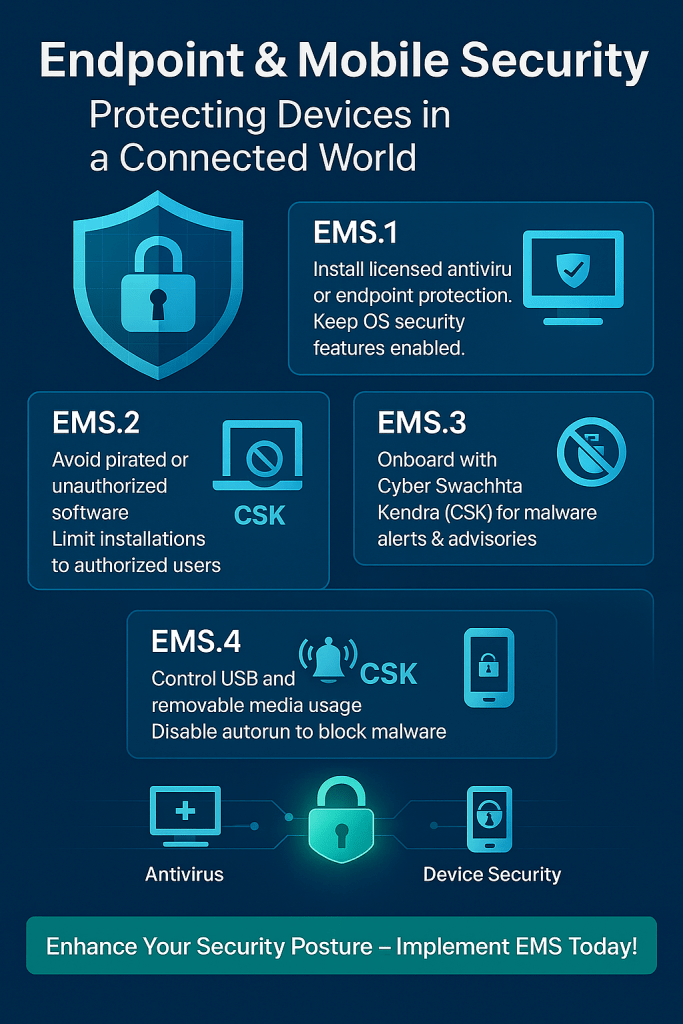
    EMS.1: Install Licensed Endpoint Protection
    • Deploy antivirus or endpoint protection software on all devices.
    • Use licensed versions for vendor support and regular updates.
    • Never disable built-in OS security features like Windows Defender or Windows Firewall.
    EMS.2: Avoid Unauthorized Software
    • Pirated software is a legal risk and a security nightmare.
    • Restrict software installation to authorized personnel only.
    • Maintain an approved software list for compliance.
    EMS.3: Leverage CERT-In’s Cyber Swachhta Kendra
    • Onboard with Cyber Swachhta Kendra (CSK) for:
      • Botnet cleaning tools
      • Malware alerts and advisories
    • Stay informed about emerging threats and remediation steps.
    EMS.4: Control USB & Removable Media
    • Restrict or monitor USB usage.
    • Disable autorun features to prevent malware spread.
    • Consider endpoint management tools for granular control.
    Real-World Example

    In 2023, a major Indian NBFC faced a ransomware attack after employees installed unauthorized software on their laptops. The malware spread through USB drives, encrypting sensitive financial data.
    Impact: Operations halted for 72 hours, causing financial losses and reputational damage.
    Lesson: Strict endpoint security policies and USB control could have prevented this breach.

    Compliance Requirements
    • ISO 27001: Requires documented endpoint security processes.
    • CERT-In Guidelines: Mandate malware protection and monitoring.
    • RBI Cybersecurity Framework: Enforces strict controls for financial institutions.
    FAQ

    Q1: Why is endpoint security critical for remote work?
    A: Remote devices often connect to unsecured networks, increasing risk.

    Q2: Can mobile devices be as vulnerable as desktops?
    A: Yes, mobile malware and phishing attacks are rising rapidly.

    Resources
    FinSequr Insight

    Endpoints are the gateway to your organization’s data. By enforcing EMS policies, you reduce risk, improve compliance, and build a resilient security posture. Remember: every device matters in the fight against cyber threats.

    Visit FinSequr.com for more cybersecurity insights or contact our experts today.

  • In today’s hyper-connected world, networks and email systems are prime targets for cybercriminals. Unauthorized access, data breaches, and phishing attacks can cripple businesses and compromise sensitive information. Network and Email Security (NES) is not just a best practice it’s a necessity.

    This post explores key strategies to safeguard your organization’s communication channels and prevent cyber threats.

    Why NES Matters

    Networks and email systems are the backbone of modern business operations. A single vulnerability can lead to:

    • Data Loss: Confidential information falling into the wrong hands.
    • Financial Damage: Costly breaches and ransomware attacks.
    • Reputation Risk: Loss of customer trust and brand credibility.

    FinSequr’s NES Best Practices

    NES.1: Deploy and Configure Firewalls

    Firewalls act as gatekeepers for your network. To maximize protection:

    • Install firewalls at the network perimeter.
    • Enable host-based firewalls on individual devices.
    • Regularly audit and update firewall rules to block unauthorized traffic.
    NES.2: Secure Wireless Connectivity

    Wi-Fi networks are often the weakest link. Strengthen them by:

    • Using WPA2/WPA3 encryption.
    • Setting strong, unique passwords and hiding SSIDs.
    • Avoiding factory-default credentials.
    • Segregating guest networks from internal systems.
    • Preventing endpoints from auto-connecting to public Wi-Fi.
    • Enforcing secure wireless configurations across all devices.
    NES.3: Implement VPNs for Remote Access

    Remote work introduces new risks. Combat them with:

    • VPNs that encrypt all traffic.
    • Multi-Factor Authentication (MFA) for added security.
    • Regular monitoring of VPN logs to detect anomalies.
    NES.4: Protect Email Systems from Phishing

    Email remains the most exploited attack vector. Secure it by:

    • Configuring SPF, DKIM, and DMARC to prevent spoofing.
    • Training employees to recognize phishing attempts.
    • Deploying advanced email filtering solutions.

    FinSequr Insight

    Cybersecurity is a continuous process, not a one-time setup. By implementing these NES practices, you create a robust defense against evolving threats. Remember: a secure network and email system is the foundation of trust in digital communication.

    Visit FinSequr.com for more cybersecurity insights or contact our experts today